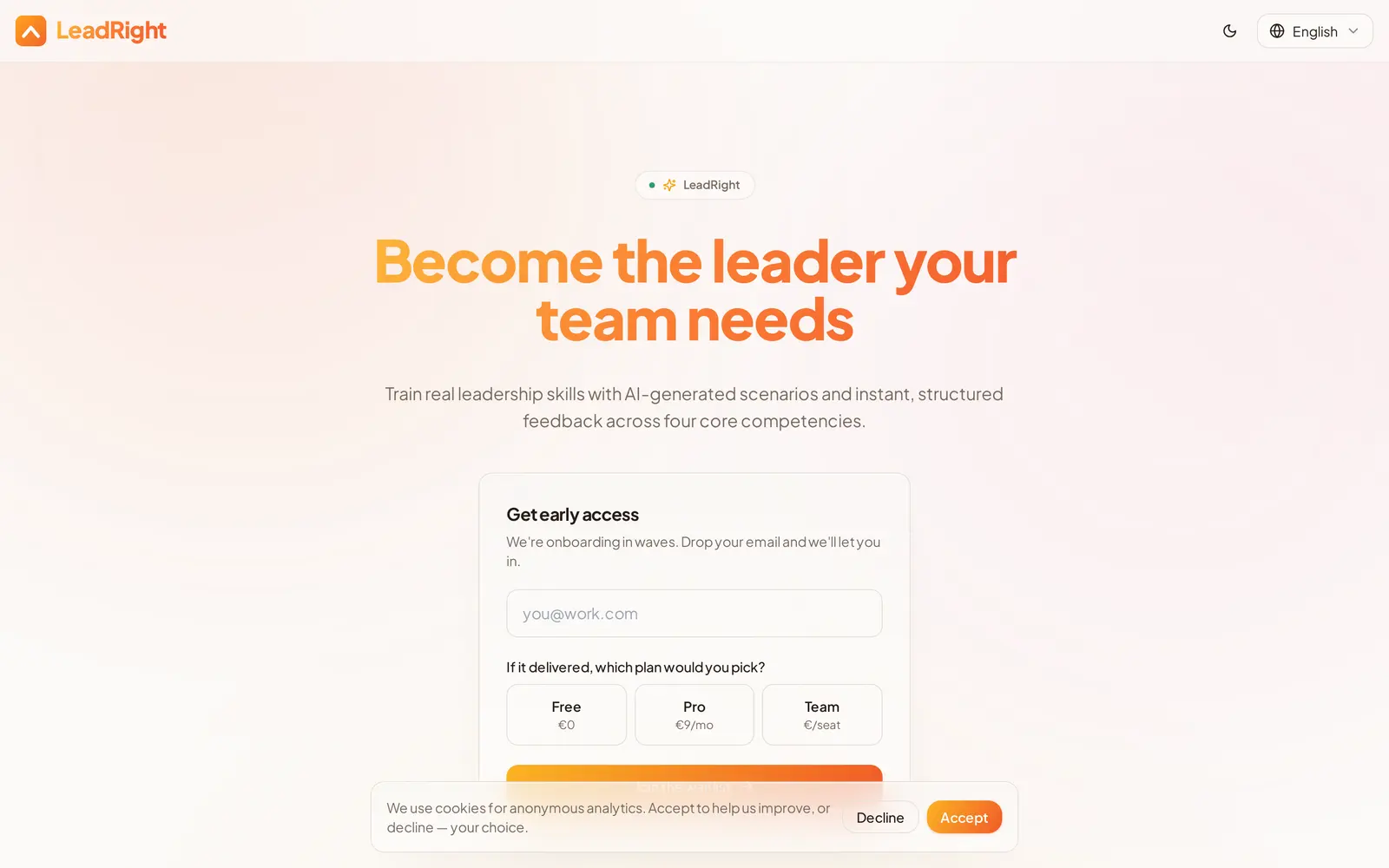
LeadRight
Management practice on scenarios that do not exist yet: a situation is generated, you work it through a few micro-decisions and one thing you would actually say, and you get scored across four competencies with the reasoning attached. Twelve languages, one of them right-to-left. The engineering worth reading about is underneath, where the cheapest path and the honest path turned out to be the same one.
A product where every interaction calls a model has an unpleasant property: the people who cost you the most are the ones who have not decided to stay yet. A new manager working through their first few lessons is pure expense, arrives during whatever hour everyone else also arrives, and forms their entire opinion of the product in exactly the window where a rate limit or an exhausted credit balance turns the experience into an error message.
The second problem is subtler and comes with scoring people. Anything that puts colleagues in an order will be read as a ranking of who is better, and in a tool bought by their employer that changes what people do with it. Both problems ended up being solved by the same instinct: decide in advance what the software is allowed to assert.
> the pre-baked tier covers the six foundational lessons, in English and Italian. everything else is live.
The first lessons never call a model
The foundational path is authored once, offline, with the score for every option decided in advance and kept server-side where the browser cannot read it. So the busiest, cheapest-to-serve, highest-stakes part of the product costs nothing per run, cannot rate-limit, and cannot fail because a credit balance ran dry overnight. Live generation is kept for the harder lessons, where volume is low and the extra invention is worth paying for. The price is content that goes stale until someone regenerates it, on the one path where staleness matters least.
Then the instant path was slowed back down on purpose
Pre-baked lessons return immediately, which reads as canned. A lesson that answers before you have finished reading the question feels like a lookup table, and the ones that take a few seconds feel like thought. So the deterministic path waits a randomised couple of seconds to sit in the same range as the live one. Deliberately spending time the architecture had just saved, because consistency of experience was judged worth more than a benchmark, with an environment flag to switch it off in tests.
A vendor interface written before there was a second vendor
Two methods, generate and score, behind one interface picked by an environment variable, so switching model vendor, running an A/B test or adding failover never reaches product code. Worth noting honestly that the abstraction is not total: content translation still calls the original vendor directly, and the two implementations differ underneath, one making two calls where the other makes one. It covers the two calls that are on the hot path and cost money, which is where an abstraction earns its keep and where it stops.
The leaderboard ranks improvement, never score
A team board sorted by absolute score teaches the strongest people to keep practising and everyone else to stop, which is precisely backwards for a training product. So the ranking is the difference between someone's recent attempts and their early ones, with consistency as the tie-break, and nobody appears until they have enough history to have a trend. It is gameable, a deliberately weak start ranks well, and that was accepted: the alternative optimises for hiding, which is worse and harder to detect.
An animation library banned after it shipped blank pages
The motion library did not run in the production build, and because its entrance animations start from transparent, content that failed to animate simply never appeared. Not a broken animation, a blank page, in production. The rule that replaced it is about failure direction rather than taste: motion is CSS, so if it does not run the content is still there. The cost is less expressive movement, in exchange for a failure mode that degrades instead of erasing.
The password on the door was mistaken for a lock
A private beta sat behind a shared password, and the admin surface leaned on it. But that perimeter is bypassed for anyone already signed in, which meant every beta user could read the whole waitlist and mint their own invites. An adversarial pass found it, and the fix separated the two ideas properly: the perimeter keeps strangers out, real authorisation decides who may do what, and the admin route now answers "not found" rather than "forbidden" so its existence is not confirmed to whoever is asking.
The pattern here is deciding, per feature, whether a model needs to be involved at all. Most of LeadRight's traffic is served by content a model wrote once, months ago, and the parts that genuinely need generation are the parts nobody sees on their first day. That is usually where the unit economics of an AI product are won or lost, well before anyone tunes a prompt. If you are costing out something similar, or you already shipped it and the bill is the surprise, let's talk.