OpsVital
A team-health platform for the humans behind the code. It fuses DORA delivery metrics with SPACE human signals and a computed tech-debt index, then shapes them into views that inform without exposing anyone. This one is less about AI and more about the harder question: how do you measure an engineering org honestly, and not weaponize the numbers?
Most engineering dashboards measure one thing (velocity) and manage to be both useless and dangerous. Useless, because story points don't tell you whether delivery is healthy or whether people are about to burn out. Dangerous, because the moment a number can be traced to a person, it stops being a signal and becomes a stick.
OpsVital is my take on doing it right: combine the signals that actually matter, compute them from real events instead of self-reports, and design the views so a manager can see a team's health without ever seeing an individual's raw numbers. The wedge it chases: six weeks of warning before a regretted resignation.
> the privacy gate isn't a setting you can turn off. it's where the data model splits what each role is allowed to resolve.
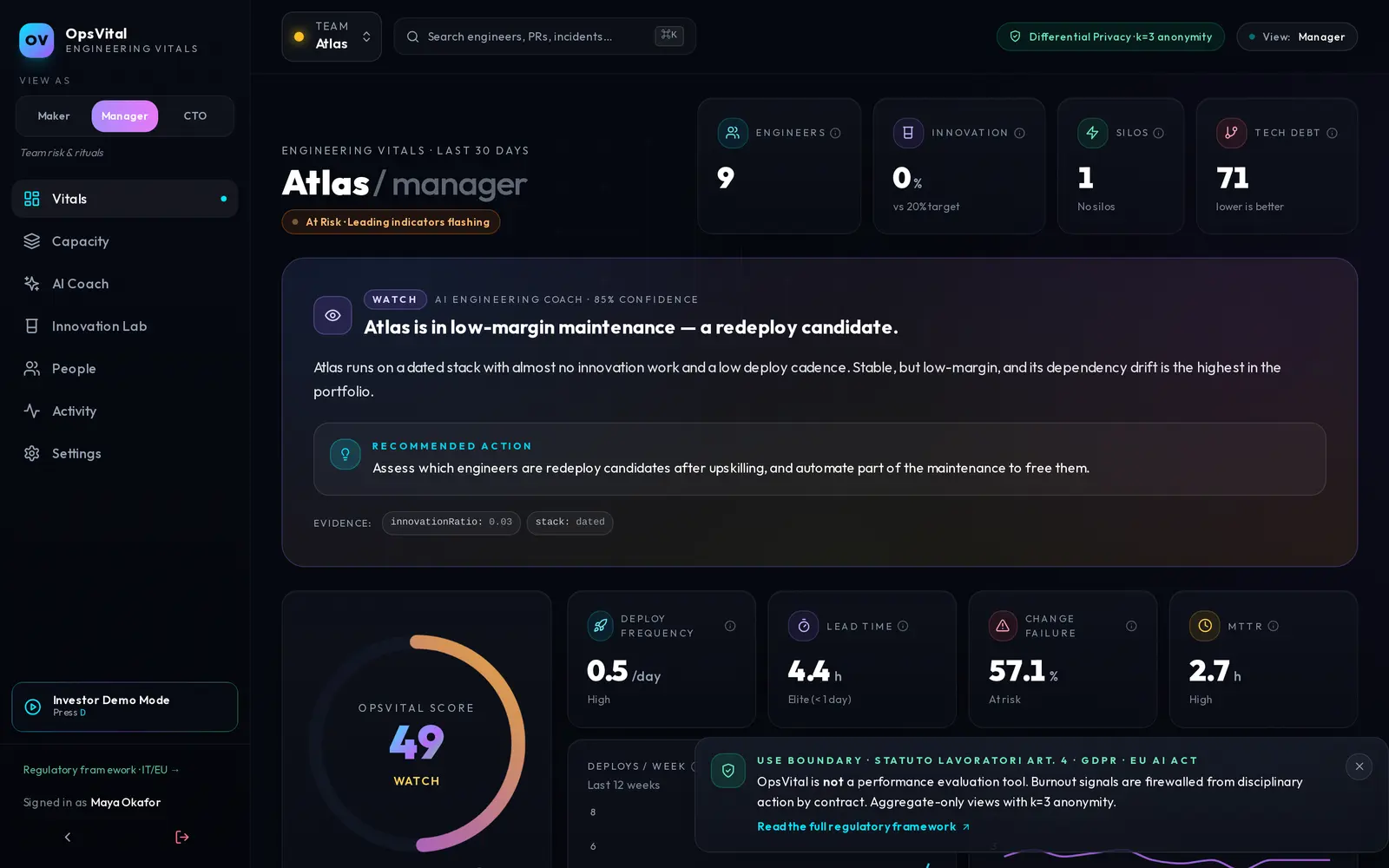
Measure delivery and humans together
DORA alone tells you the machine is fast; SPACE tells you the people are fine, or aren't. Read separately they mislead, a team can hit elite deploy frequency on its way to collapse. OpsVital fuses both into one score with a burnout signal, so the delivery number and the human number are never looked at in isolation.
Privacy is in the data model
The Maker sees only their own flow and is never ranked against peers. The Manager sees team aggregates under k=3 anonymity, never an individual's raw row. The CTO sees rollups and forecasts, not names. Trust isn't a policy you promise, it's what the queries are structurally allowed to return per role.
Tech-debt as a computed proxy
Not a gut feel or a Jira label. A code-health index is computed from real signals, dependency freshness (libyear-style), rework ratio, maintenance-vs-feature commit mix, and change-failure rate, straight from git and GitHub webhooks. It's framed honestly as a proxy, not a verdict, but it moves when the codebase moves, which a survey never does.
Leading indicators, not autopsies
Most attrition dashboards explain a resignation after it lands. The whole design goal here is the opposite: surface the drift, falling flow, rising after-hours, thinning collaboration, weeks before it becomes a goodbye email. Managing a team is acting on the leading signal; the lagging one is just a receipt.
OpsVital is where my architecture side meets the leadership side. Half of what I do for clients isn't code, it's helping engineering leaders see their org clearly: which metrics to trust, how to measure people without surveilling them, how to catch burnout and delivery risk before they cost you a hire. This build is that thinking made concrete. If that's the conversation you need, let's have it.